
ISO/TC 114 Congress in Zhangzhou
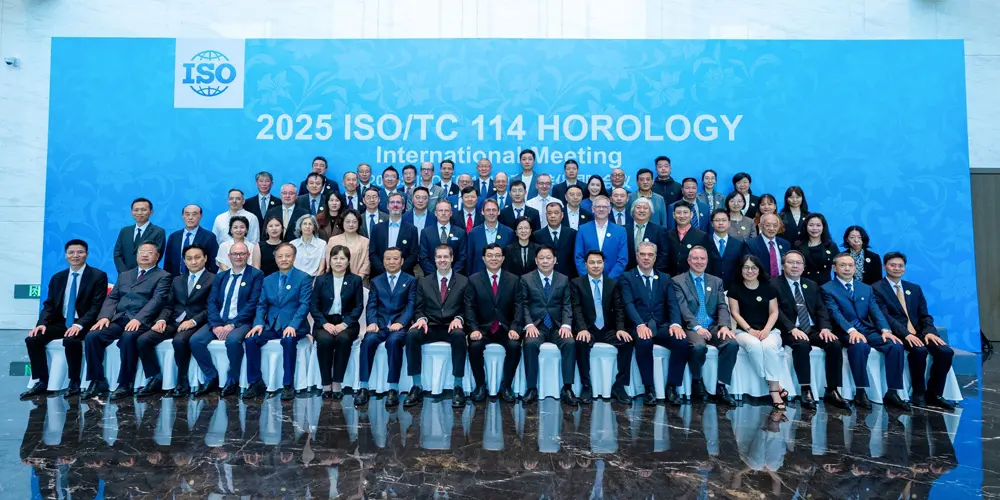
Exceptional is perhaps the word that best describes the ISO/TC 114 - Horology Congress held from 12 to 16 May 2025 in Zhangzhou, Fujian Province, China. This city of five million inhabitants is home to numerous companies specialising in the manufacture of watchmaking components and products.
The magnificent Pien Tze Huang Spring Hotel provided the setting for the event, hosting not only the working meetings but also several major occasions: the opening ceremony, the launch of the Bluelight Cup Watch Design Competition, official dinners and an exhibition celebrating the technical committee's 60-year history.
The event received outstanding support from the local authorities, both financially and through the active participation of the mayor and several deputy mayors in the programme.
Nearly 50 delegates from China, France, Hong Kong, Japan, Mongolia and Switzerland gathered for a week of work on various standardization projects. The hybrid format also enabled experts from Germany and the United Kingdom to participate occasionally by videoconference.
All participants praised the excellent organisation of the congress, the quality of the services provided and the logistical support.
In his welcome address, ISO/TC 114 Chair Raphaël Schwarz outlined the week's work programme and emphasised the importance of preparing for the future to improve the technical committee's effectiveness. Participants also had the honour of hearing welcoming speeches from Wang Jinzu, Secretary of the Zhangzhou Municipal Committee, the mayor and other representatives of the city and Chinese watchmaking associations. The official proceedings included the launch of the seventh Bluelight Cup Watch Design Competition, highlighting emerging talent in watch design.
During the plenary meeting, the week's programme was presented, delegates were introduced and subcommittee reports were shared. A presentation was also given on ISO's new online standards development tool. A proposal to reorganise the technical committee was discussed throughout the week, resulting in a plan to reduce the number of subcommittees and optimise the allocation of standards among them.
Subcommittee 3, responsible for water-resistant watches, focused on organising a round-robin interlaboratory study to improve the condensation test described in ISO 22810. Several countries undertook to provide samples (watches or watch cases) and participate in the interlaboratory testing. This work was expected to lead to a revision of the standard.
Subcommittee 6, recently reactivated to revise the standard on physical vapour deposition (PVD) coatings, examined numerous comments and suggestions for improving ISO 16253. The next step would be to prepare a draft standard for ballot.
Subcommittee 9 continued its revision of ISO 6426-2 on horological vocabulary. The project was in its final stage, with publication expected in the coming months.
Subcommittee 13 was evaluating new tests, particularly tests involving cosmetic products, to supplement those in ISO 14368-4 on anti-reflective treatments for watch-glasses. Following a proposal from China, it was also decided to launch a new standardization project on anti-fingerprint treatments.
Subcommittee 14, inactive since 2020, resumed its activities with two projects for analogue quartz clocks: one on measuring movement noise and the other on the fitting dimensions of movements within clock cases.
The working group on chemical regulatory compliance reviewed comments received on the Draft International Standard (DIS). A Final Draft International Standard (FDIS) would soon be circulated for consultation, with the aim of publishing ISO 16359 by the end of 2025.
The working group on watch batteries reviewed the work of IEC/TC 35 and decided to revise ISO 12819 on assessing the battery life of battery-powered watches, in order to include rechargeable batteries.
Delegates were also informed about the new Chinese standard GB 44702-2024, concerning restrictions on hazardous substances in watch cases in prolonged contact with the skin. One notable feature of the standard is that it imposes nickel-release requirements on components not in prolonged contact with the skin, such as rotating bezels.
The closing session reviewed the results of the week: oral reports, adoption of resolutions, an update to the business plan and confirmation that the next ISO/TC 114 Congress would be held in Ulaanbaatar, Mongolia, in 2027. Finally, delegates present on the last day enjoyed a sunny excursion to the Fujian Tulou, a convivial and much-appreciated conclusion to an intensive week.