
ISO/TC 114 Congress in Marseille
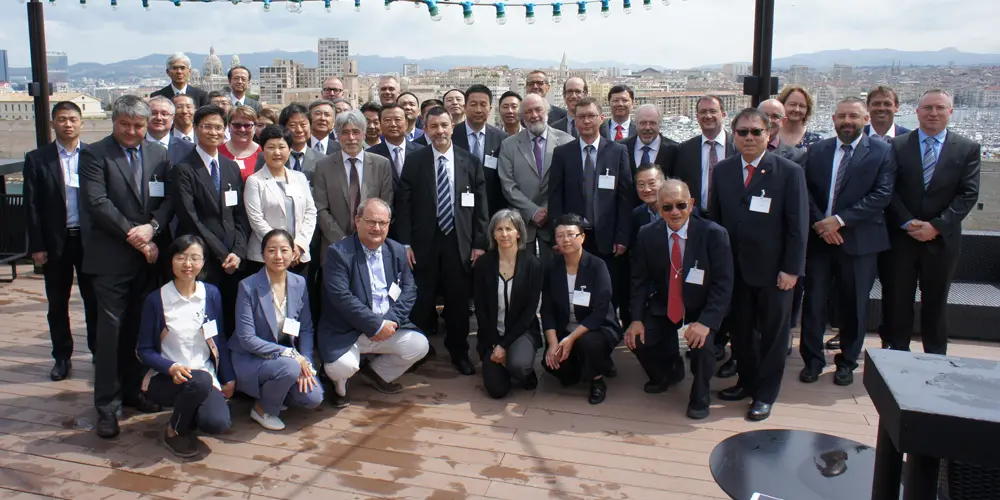
Marseille's Vieux-Port (Old Port), the city's historical and cultural heart, is its oldest harbour. This picturesque setting hosted the 24th International Congress of ISO/TC 114 - Horology, meticulously organised by the French delegation and attended by nearly 40 experts from China, France, Germany, Hong Kong, Japan, Russia and Switzerland.
In his welcome address, Chairman Silvano Freti focused on consumer expectations. More broadly, standards are evolving: once primarily a quality-control tool, they now also facilitate trade along supply chains and increasingly serve to inform, and even protect, consumers. This trend can also be seen in ISO standards relating to horology.
The congress began with a full day of training on ISO directives and procedures. It was intended mainly for people holding ISO responsibilities, such as chairing a subcommittee, convening a working group or acting as its secretary. The session proved particularly informative and useful and was greatly appreciated by all participants.
Overall, international standardization work is progressing satisfactorily, albeit sometimes in small steps. The main topic was water-resistant watches: a working group established after the 2017 congress had recommended revising ISO 22810 - Water-resistant watches. Following extensive discussions, it was ultimately decided not to launch a revision at that stage. Instead, the working group would remain active and continue its work on the condensation test. A possible revision of the standard could be decided in 2021.
Other standardization activities included primary and rechargeable batteries, including those used in watches, which are dealt with by IEC/TC 35 in liaison with ISO/TC 114. Two resolutions were adopted concerning the dimensional requirements and tolerances for button cells.
The revision of ISO 764 on magnetic resistance, under way since early 2016, was nearing completion and the revised standard was expected to be released during the year. The final discussions addressed the minimum resistance to magnetic fields, the test method and the marking of magnetic-resistant watches.
Work on the standard covering anti-reflective treatments for watch-glasses also made significant progress, and the new ISO 14368-4 standard was expected to be published in the following months.
The draft standard concerning watches made with hard materials was also nearing completion. The final section, dealing with the mechanical behaviour of assembled components, had been completed. The new ISO 18684 - Timekeeping instruments - Watch external parts made of hard material - General requirements and test methods was expected to be published by the end of the year.
The draft standard for radio-controlled clocks was likewise making steady progress and was expected to be finalised during 2020.
Finally, ISO/TC 114/SC 5 - Luminescence decided to withdraw ISO 4168 and incorporate its relevant provisions into the revision of ISO 17514 on photoluminescent deposits. Initial comments on the revision were discussed and would be incorporated into the next draft, to be submitted for a vote shortly thereafter.
On the final afternoon, delegates had the opportunity to visit Compagnie maritime d'expertises (Comex), a specialist in deep-sea diving, before saying their farewells and looking ahead to the next ISO/TC 114 International Congress on Horology. Owing to the coronavirus pandemic, that congress would take place in 2021 by videoconference, hosted by the Federation of the Swiss Watch Industry FH.